Posted by Cyrille A. on Saturday, September 26, 2009,
Ōmisoka
Ōmisoka (大晦日?),
New Year's Eve, is
the second-most important day in Japanese tradition because it is the final
day of the old year and the eve of New Year's Day, which is the most important
day of the year.
People tend to be very busy on Ōmisoka because they have much to do to
prepare for the new year, and New Year's Day in particular. Many even do a
thorough house cleaning, called ōsōji (大掃除). The exercise is much like the annual spring cleaning that
people in... Continue reading ...
Shichi-Go-San - Matsuri
Posted by Cyrille A. on Saturday, September 26, 2009,
Shichi-Go-San

Japanese
girls at a shrine, dressed up for the Shichi-Go-San festival
Shichi-Go-San (七五三,
seven-five-three?)
is a traditional rite of
passage and festival day in Japan for three and seven year-old girls and five year-old boys, held annually on November
15. As Shichi-Go-San is not a national holiday, it is
generally observed on the nearest weekend.
History
Shichi-Go-San is s... Continue reading ...
Bon Festival - Matsuri
Posted by Cyrille A. on Saturday, September 26, 2009,
Bon Festival
Illuminated
by the Albuquerque Bridge, Japanese volunteers place candle lit lanterns into
the Sasebo River
during the Obon festival. 
Obon (お盆?)
or just Bon (盆?)
is a Japanese Buddhist custom to
honor the departed (deceased) spirits of
one's ancestors. This Buddhist
custom has evolved into a family reunion holiday during which people
return to ancestral family places and ...
Tanabata - Matsuri
Posted by Cyrille A. on Saturday, September 26, 2009,
Tanabata

Women
dressed in yukata at
Tanabata
Tanabata (七夕, tanabata?,
meaning "Evening of the seventh") is a Japanese star festival, derived from the Chinese star festival, Qi Xi (七夕 "The Night of
Sevens").
It celebrates the meeting of Orihime (Vega) and
Hikoboshi (Altair). The Milky Way, a river made from stars that crosses the
sky, separates these lovers, and they are allowed to meet only once a year on
the seventh day of the seventh lunar month of the lunisolar calend... Continue reading ...
Hanami (flowers) - Matsuri
Posted by Cyrille A. on Saturday, September 26, 2009,
Hanami
Hanami (花見?,
lit. "flower viewing") is the Japanese traditional custom of enjoying the beauty of flowers, "flower" in this case almost
always meaning cherry
blossoms (桜 or 櫻, sakura?),
or ume
blossoms (梅, ume?).
From mid January to early May, sakura bloom all over Japan. The blossom forecast
(桜前線, sakurazensen?,
lit. cherry blossom front) is announced each year by the weather
bureau, and is watched carefully by tho... Continue reading ...
Hinamatsuri (Doll Festival) - Matsuri
Posted by Cyrille A. on Saturday, September 26, 2009,
Hinamatsuri
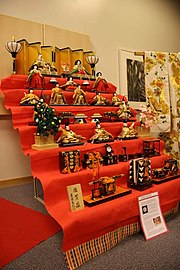
Seven-tiered
Hina doll set
The Japanese Doll Festival (雛祭り, Hina-matsuri?),
or Girls' Day, is held on March 3, the third day of the
third month. Platforms with a red hi-mōsen are used to display a set of
ornamental dolls (雛人形, hina-ningyō?)
representing the Emperor, Empress, attendants, and musicians in
traditional court dress of the Heian period.
Continue reading ...
Japanese New Year - Matsuri
Posted by Cyrille A. on Saturday, September 26, 2009,
Japanese New Year
The
kadomatsu is a traditional
decoration for the new year holiday. 
The Japanese
celebrate New Year's
Day on January 1 each year on the Gregorian Calendar.
Before 1873, the date of the Japanese New Year (正月, shōgatsu?)
was based on the Chinese lunar calendar and celebrated at the
beginning of spring, just as the contemporary Chinese, Korean and Vietnamese New Years are celebrated to this day.
However, in 1873, five years after the Meiji Restoration, Japan ad...
Japanese Festivals
Posted by Cyrille A. on Saturday, September 26, 2009,
Japanese festivals

Stalls
selling food or toys are a familiar sight at festivals throughout
Japan.

The
procession of a thousand warriors is the highlight of the autumn festiva...
|
|


